

Barbecue, fruitcake, and pecan pie all have their place at the table during the holidays, but it wouldn’t be a true Texas Christmas, especia...
4 min read
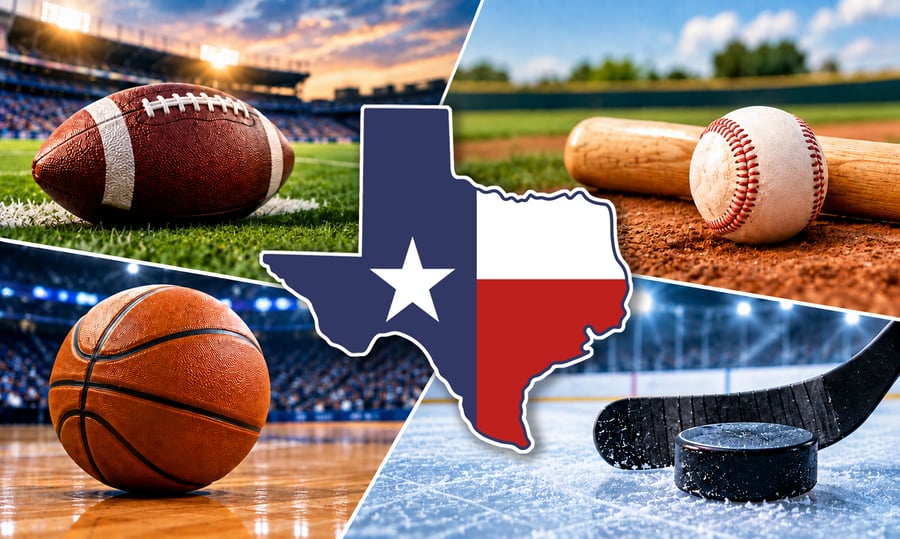
Texas has never had a shortage of sports.
From Friday night high-school football to packed college stadiums and championship-winning professional franchises, sports are deeply woven into the state’s identity. But when it comes to the four major North American professional leagues, the NFL, MLB, NBA and NHL, Texas may be entering an especially interesting period.
As of September 2026, Texas is home to eight “Big Four” franchises: the Dallas Cowboys and Houston Texans in the NFL; Texas Rangers and Houston Astros in MLB; Dallas Mavericks, Houston Rockets and San Antonio Spurs in the NBA; and Dallas Stars in the NHL.
That is already an impressive professional sports footprint. But it is also unevenly distributed.
Dallas–Fort Worth has representation in all four leagues. Houston has the NFL, MLB and NBA, but no NHL franchise. San Antonio has the Spurs. Austin, despite its rapid growth and emergence as a major sports and entertainment market, has no Big Four franchise.
That could soon change.
The NHL is Texas’ Most Immediate Expansion Opportunity
Of all four leagues, the NHL currently presents the clearest path toward another Texas franchise.
In June 2026, the NHL announced a six-month evaluation process with the Friedkin family, led by Houston billionaire Dan Friedkin, to explore placing an expansion franchise in either Houston or Austin. The potential team would become the NHL’s 33rd franchise.
The discussions are significant. NHL Commissioner Gary Bettman said the league had been talking with the Friedkin family for roughly two years, initially focusing primarily on Houston before Austin emerged as another possibility. The overall investment could reach approximately $3.5 billion, including an expansion fee and a new arena. Both Houston and Austin would require a new arena for the plan to move forward.
Since then, the possibility has become even more tangible.
In August, NHL Deputy Commissioner Bill Daly said the process was moving forward and that another update was expected within weeks. A franchise could potentially be awarded by the end of 2026 and begin playing during the 2029–30 season. Houston is currently considered the frontrunner, although Austin remains under consideration.
Houston makes plenty of sense. It is one of the country’s largest markets and already supports three Big Four franchises. An NHL team would complete the city’s major-league lineup and create an immediate in-state rivalry with the Dallas Stars.
Austin presents a very different opportunity. The NHL could become the first of the Big Four leagues to establish a franchise in one of America’s fastest-growing major markets.
Either way, this has moved beyond casual expansion speculation. Texas is officially being evaluated for another NHL team.
Could MLB Be Next?
Major League Baseball presents another intriguing possibility, particularly in Central Texas.
Commissioner Rob Manfred has repeatedly discussed expanding MLB from 30 to 32 teams and has said he wants the two expansion cities selected before his term ends in January 2029.
Austin is already preparing.
The Austin Baseball Commission, through its ATX MLB initiative, is building a formal case for bringing Major League Baseball to the city. Its pitch emphasizes Austin’s population growth, corporate presence, culture and ability to support major sporting events. The organization sees Austin not simply as an individual city but as the center of a much larger Central Texas market.
San Antonio has also been part of the MLB expansion conversation, creating the possibility that Central Texas could eventually be marketed as a broader Austin–San Antonio opportunity.
The challenge is competition.
If MLB adds only two franchises, Texas will be competing against other markets around the country that have spent years positioning themselves for expansion. There is also the question of whether MLB would prioritize adding a third Texas team over entering a state or region without an existing franchise.
Still, the Austin–San Antonio corridor makes the conversation worth watching. Continued population and economic growth could make Central Texas increasingly difficult for professional sports leagues to overlook.
Another NBA Team is Much Less Likely
If Austin wants a Big Four franchise, basketball probably isn’t its best bet.
Texas already has three NBA franchises, the Mavericks, Rockets and Spurs and the league has identified two other markets as the focus of its current expansion exploration.
In March 2026, San Antonio has also been part of the MLB expansion the league to explore potential expansion into Seattle and Las Vegas. Commissioner Adam Silver has stressed that expansion isn’t guaranteed, but the league is specifically evaluating those two cities rather than opening a nationwide competition for franchises.
Austin also sits firmly within the broader San Antonio Spurs ecosystem. The Spurs’ NBA G League affiliate, the Austin Spurs, plays its home games at the H-E-B Center at Cedar Park.
With three existing Texas NBA teams and Seattle and Las Vegas at the front of the current expansion discussion, a fourth Texas NBA franchise appears unlikely for the foreseeable future.
What About the NFL?
Then there is football.
On paper, an Austin-San Antonio NFL franchise is fascinating. Together, the two metropolitan areas represent a huge and growing population, and few places have a stronger football culture than Texas.
San Antonio has also demonstrated its ability to host major sporting events at the Alamodome, while Austin’s growth has dramatically increased Central Texas’ corporate and economic influence.
The obstacle is simple: there isn’t currently an NFL expansion process offering Central Texas a team.
The NFL already has 32 franchises, including the Cowboys and Texans and its recent growth strategy has focused heavily on expanding its international presence rather than adding domestic teams. The 2026 season, for example, includes a record nine international games across seven countries.
If the NFL someday decides to grow to 34 or 36 teams, however, it would not be surprising to see Austin and San Antonio enter the discussion.
Austin May Be the Biggest Wild Card
The most interesting city in all of this may be Austin.
Austin has emerged as a major professional sports market without yet landing an NFL, MLB, NBA or NHL franchise. Austin FC has demonstrated the city’s appetite for top-level professional sports, while Formula 1’s presence at Circuit of the Americas has further strengthened Austin’s reputation as a sports destination.
That makes the NHL’s current Houston-versus-Austin evaluation particularly consequential.
If Houston lands the NHL franchise, Austin remains an untapped Big Four market, potentially strengthening its case when MLB expansion moves forward.
If Austin gets the NHL team, the dynamic changes. The city would suddenly have a major professional franchise competing for corporate sponsorships, premium seating, media attention and consumers’ entertainment dollars. That could influence the economics of a future MLB bid.
What Could Texas Sports Look Like in 10 Years?
The most likely near-term addition appears to be an NHL franchise in Houston. The process is active, an ownership group is involved and the league is openly evaluating the market.
After that, Central Texas becomes the region to watch.
An Austin or Austin-San Antonio MLB franchise is plausible if MLB moves to 32 teams, although competition for those limited expansion slots will be intense. An NFL franchise in Central Texas remains an intriguing long-term idea rather than an immediate possibility. A fourth NBA franchise in Texas appears the least likely scenario.
But even one successful expansion would be significant.
Texas already has eight Big Four franchises. A Houston NHL team would bring that number to nine and give both Dallas–Fort Worth and Houston representation across all four major leagues.
And if Central Texas eventually breaks into the Big Four as well, the state’s professional sports map could look considerably different a decade from now.
For now, all eyes should be on the NHL.
The question is no longer simply whether Texas could support another major professional sports franchise.
It’s whether Houston or Austin will get one first.