

Part of the charm of Texas is the number of legendary dance halls and honky-tonks across the state where you can listen to great music, two-...
5 min read
Fall in Texas brings plenty of familiar traditions: Friday night football, packed stadiums, marching bands, pep rallies, homecoming courts and school colors everywhere you look. But there is one tradition that can be especially surprising to anyone who didn’t grow up in the Lone Star State: the Texas homecoming mum.
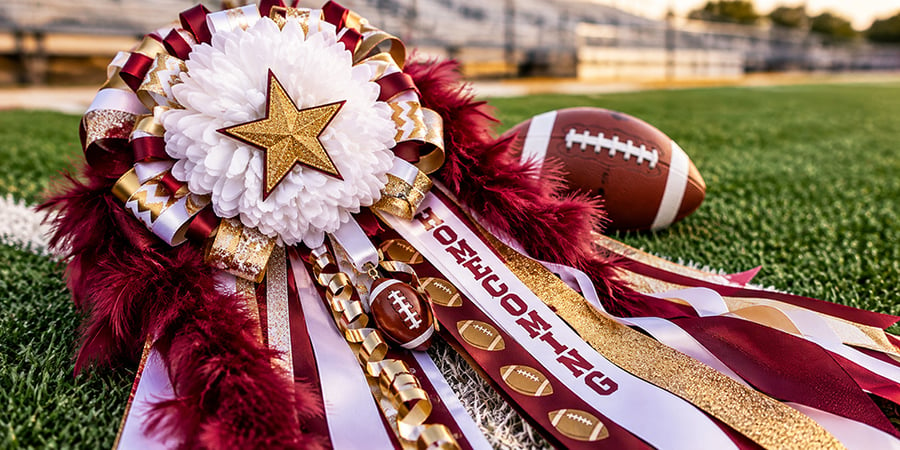
Covered in ribbons, bells, charms, glitter, flowers and personalized decorations, today’s homecoming mums can be impossible to miss. Some stretch from a student’s shoulders nearly to the floor, while others feature multiple flowers, stuffed mascots, lights and elaborate ribbon designs.
Yet the Texas homecoming mum wasn’t always so extravagant.
What began as a relatively simple floral gesture has evolved over generations into a unique expression of school spirit, creativity and Texas culture. Here’s how the tradition began and how Texas turned a chrysanthemum corsage into one of the most recognizable parts of homecoming season.
Where Did the Homecoming Mum Tradition Begin?
Despite how closely homecoming mums are associated with Texas today, the tradition itself may not have originated in the state.
The history is connected to the development of homecoming celebrations in the United States. The University of Missouri is widely associated with one of the earliest modern homecoming celebrations, holding its famous homecoming football event in 1911.
As homecoming celebrations became increasingly popular at colleges and eventually high schools, flowers became part of the festivities. Young men would give their homecoming dates chrysanthemums, often decorated with a few ribbons.
According to Texas Highways, homecoming mums are believed to have appeared in Texas by the 1930s, although similar traditions involving chrysanthemums existed elsewhere.
The choice of flower made sense. Chrysanthemums or “mums” are traditionally associated with fall, making them a natural fit for football and homecoming season.
At the time, however, a homecoming mum looked much more like a traditional corsage than the creations Texans recognize today.
From a Flower to a Texas Tradition
The earliest mums were typically real chrysanthemums.
A student might receive a large chrysanthemum decorated with a handful of ribbons in the school’s colors. The flower could then be pinned to clothing and worn during homecoming activities, including the football game or dance.
It was a relatively simple tradition centered on giving someone a flower.
Once the custom took hold in Texas, however, it began developing a personality of its own.
Over time, additional ribbons and decorations were added. School colors became increasingly important, and students began personalizing their mums with details representing their schools, activities and relationships.
By the 1970s, the arrangements were becoming increasingly elaborate, with trinkets, ribbons, garland and other decorations appearing alongside the traditional flower.
The homecoming mum was becoming more than a corsage.
It was becoming a statement.
Bigger, Brighter and More Elaborate
During the 1980s and 1990s, the Texas philosophy of “bigger is better” became especially apparent in homecoming mums.
Instead of a single flower and several ribbons, students increasingly wore arrangements featuring multiple flowers and layers of decorations.
Long ribbons could display the student’s name, graduation year, school name or mascot. Bells and metallic decorations added movement and sound. Footballs, helmets and other sports-themed items celebrated the homecoming game.
Artificial flowers also became increasingly common.
Real chrysanthemums were beautiful, but they had practical limitations. They could wilt or become damaged and there was only so much weight a real flower arrangement could support. Artificial mums allowed creators to build larger and more intricate designs while giving students something they could keep long after homecoming ended. Texas Highways notes that the transition to artificial flowers helped pave the way for increasingly extravagant designs, particularly by the 1990s.
Eventually, the mum wasn’t simply something pinned near the shoulder.
Some became so large that they needed ribbons or straps around the wearer’s neck to support their size.
What Goes on a Texas Homecoming Mum?
One of the reasons the tradition has remained popular is that there really isn’t one standard design.
A modern mum can tell a story about the student wearing it.
School colors usually provide the foundation, but virtually everything else can be personalized. A mum might feature the student’s name, jersey number, graduation year, extracurricular activities, favorite interests or references to friends and relationships.
Common decorations include ribbons, bells, beads, braids, glitter, charms, stuffed animals, miniature footballs, school mascots, feathers and even LED lights.
Seniors may also follow special color traditions. At some Texas schools, senior mums incorporate white, silver or gold rather than relying exclusively on traditional school colors. Traditions can vary significantly from one school or community to another.
The result is something closer to wearable memorabilia than a traditional corsage.
For many students, that’s exactly the appeal.
Don’t Forget the Homecoming Garter
Mums aren’t the only wearable homecoming tradition in Texas.
Garters developed as the traditionally male counterpart to the homecoming mum. Instead of being worn on the chest or around the neck, the smaller arrangement is typically worn around the upper arm.
Like mums, garters can feature school colors, ribbons, bells, names, charms, mascots and personalized decorations.
Historically, homecoming dates might exchange the two, a boy giving his date a mum and receiving a garter in return. Today, those rules are far less rigid.
Students may purchase mums for themselves, receive them from parents or friends, exchange them with dates or create them as part of a group. The tradition has become increasingly flexible and inclusive, allowing students to participate in whatever way makes sense for them.
Homecoming Mums Become an Art Form
Perhaps the biggest change in the tradition has been the level of craftsmanship involved.
Making mums has become a serious creative endeavor for many Texas families, students and professional designers.
Intricate ribbon braids may take hours to complete. Decorations are carefully layered and arranged. Personalized elements can be created specifically for an individual student.
For some families, making a mum together has become its own homecoming tradition.
Parents who wore mums when they were teenagers now help their children create theirs. Friends gather to make mums and garters together. Craft stores fill with ribbons and supplies in school colors as homecoming season approaches.
Professional mum makers have also turned the tradition into seasonal businesses, creating increasingly sophisticated custom designs.
The UT San Antonio Institute of Texan Cultures has even explored the cultural and creative significance of the tradition through its “MUMENTOUS®: The Upsizing of a Texas Tradition” exhibition, highlighting the people and particularly the women who have helped transform mum-making into a distinctive Texas craft.
How Big Can a Mum Get?
Today’s mums can range from relatively modest designs to enormous creations that cover much of the wearer’s body.
And occasionally, Texans take “everything is bigger” to an entirely different level.
Students at Texas high schools have collaborated on enormous display mums as school projects. Lewisville High School fashion design students won the Guinness World Record for the largest mum, creating a homecoming mum measuring approximately 27 square meters (almost 300 square feet!), demonstrating just how far the tradition has come from its corsage-sized beginnings.
While most students aren’t walking into school wearing a 27-square-meter mum, the achievement captures the playful creativity that has become associated with the tradition.
More than a Homecoming Accessory
The homecoming mum has changed dramatically over the decades, but its purpose has remained surprisingly consistent.
It’s about celebrating.
A mum celebrates a school, a football team, friendships, relationships, activities and a milestone in a student’s high school experience. Because they’re so personalized, mums can also become keepsakes that capture a specific moment in someone’s life.
Years later, an old mum can still hold memories of Friday night lights, pep rallies, marching bands, friendships and homecoming dances.
That’s part of what makes the tradition special.
A simple chrysanthemum could have disappeared as fashions changed. Instead, generations of Texans continued adding their own ideas to it.
A flower gained ribbons.
The ribbons gained bells.
The bells were joined by charms, braids, mascots, stuffed animals, glitter and lights.
And somewhere along the way, a simple homecoming corsage became unmistakably Texan.
A Texas Tradition that Keeps Evolving
Homecoming mums today look dramatically different from those worn decades ago and there’s a good chance they’ll continue changing.
New materials, crafting techniques and trends allow every generation to put its own spin on the tradition. What remains constant is the enthusiasm behind it.
For Texans who grew up with mums, seeing school hallways filled with ribbons and hearing bells jingling during homecoming week can immediately bring back memories. For newcomers, the size and extravagance may require a little explanation.
But that’s part of the fun.
Homecoming mums are colorful, creative, sentimental, occasionally over-the-top and deeply connected to local communities.
In other words, they’re a pretty fitting Texas tradition.